Monday, August 30, 2010

Hear Us Discuss the "Jaws" Franchise

Ep. 3 - Jaws - August 2010


Featuring special guest Luke Hickman, film critic for The Reel Place.com and host of the Talking Pictures Podcast


Considering the Sequels is a monthly film podcast that examines the merits and weaknesses of specific movie franchises.


In Episode 3 we consider the “Jaws” movies. This episode also includes a concept discussion in which we talk about creative sequel titling. And, as always, we each give mini reviews of recent film releases — including a mandatory “Inception” discussion — and whatever else we’ve been watching lately.


Tuesday, August 10, 2010

New CTS Podcast Host Comments on 3-D

Editor's Note: August's forthcoming episode of the Considering the Sequels podcast will reveal a new surprise host: actor Karl Huddleston. The following post found below is Karl's response to seeing his favorite magazine "going gaga" over 3-D. This is Karl's letter to the magazine's editor:


Dear Home Theater Magazine Editor,


I can't keep my pie-hole shut any longer on this whole 3-D fad. I found three separate online surveys that say the number of Americans that currently wear some type of eyeglasses is around 76 percent. I fall into that percentage (more on that in a moment). The last 3-D movie I went to was Scrooge ["A Christmas Carol"] last Christmas. And it was by accident — a friend bought the tickets.


I can't describe how much the picture sucked. Contrast and Brightness were pathetic, and the picture was so dark — add to that having to wear a pair of 3-D glasses on top of (in front of?) my regular glasses — it gave me a nice throbbing headache at the end. And this was in a new multiplex that had all DLP projectors. By the time I left I was Scrooge!


It seems to me that Hollywood is trying to shove down the public's throat, something that is not ready for prime time, whether we want it or not! I work in the film and TV industries and have many friends also that are in it ... Not a single one of them goes to 3-D movies; they all hate them for the same reasons I've described above.


I realize that the equipment manufacturers and magazines like yours feel compelled to chase the latest buzz item, but I really can't believe that many people are loving this. And despite what the pinhead at HomeTheaterExpert.com said about Roger Ebert living in 1999, Ebert nailed it right on the head when he basically said that if you know anything about the true purpose of what a motion picture is supposed to do, adding a third dimension is nothing more than pure gimmickry. It doesn't make a character more compelling, a story more moving or a picture more "watchable."


Until 3-D has as good a picture quality as a Blu-ray, like "Star Trek," without having to wear glasses (which the experts say is about five years out), I think it's going to rank up there with DIVX, the horrible "watch and toss" rental plan for DVDs, which incidentally, I think also came out in 1999.


I have never, in my life, seen a bigger case of "The Emperor Has No Clothes"! In fact, he's butt-naked — and in 3-D!


Sincerely,

Karl Huddleston

Provo, Utah


Sunday, August 8, 2010

Danny the Drama

by Jason Pyles


Sure. Viewer expectations can make or break a movie.


Case in point: Ang Lee’s “Hulk” (2003). If we all weren’t expecting to see an action-packed superhero movie, it would have been fine; instead, it was an underrated, brooding character conflict whose subject also happened to transform into a bouncy green cartoon.


Minor spoiler follow for “Unleashed.”


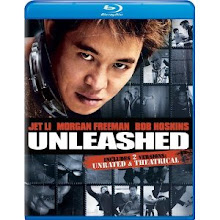
So, in his post below, where Andy reasonably expected the Jet Li vehicle “Unleashed” (aka “Danny the Dog”) to be a martial arts film, I can see why he would be disgruntled by the lengthy, sentimental second act.


Indeed, this film is actually a drama masquerading as a martial arts action flick. The first act delivers Jet Li doing what he does best, as does the third act, to some extent. But the second act shifts from martial arts into drama, and it’s a cold shower in terms of pacing.


So I guess that’s problematic. I like the film, but since we’re on the subject of the film’s imperfections, I’ll list my criticisms first:


My biggest complaint is the impossibly inconsistent character of Danny. Jet Li’s dramatic performance is convincing enough, but the actual character himself could not exist as he is portrayed. I have lengthy arguments for this, but I’ll try to briefly describe a couple of instances below:


For example, his vocabulary and communication skills — not to mention his comprehension skills — vary drastically depending on what the plot requires.


And the collar prop does not function or affect Danny the same way during the course of the movie, either. (It was intended that Danny would change, but his behaviors associated with the collar vary in such a way that is inconsistent with the expected arc.)


Uncle Bart can touch the collar anytime without Danny flinching, but no one else can. Before Uncle Bart can remove the collar, at one point, Bart’s enemies get the upper hand and Danny seems to be oblivious to his caretaker’s pleas for help. Yet others can speak to him while he’s wearing the collar, and he understands them. Oh, and later we learn that Danny is completely aware of the brawl in the grocery store.


This really is a big deal because Danny’s collar is the linch pin of this film’s premise.


So, while this film is a great idea — as an action movie or a drama — its main character is poorly conceived and the premise is broken.


Speaking to Andy’s critique of the martial arts sequences, I see his point there, too. While some interactions really seem brutal — as in, the actors actually hit one another — most of the time, it looks like a dress rehearsal. Andy calls it “play fighting.”


But overall, I still enjoyed the film — perhaps because Andy primed my expectations. I was prepared and therefore more willing to slow down for the second act of the movie. And though I vowed to try to defend this film against Andy’s critique below, I’m having trouble articulating the undeserved affection I feel toward it. But I think it’s worth the time, and it’s far more tolerable than “The Forbidden Kingdom.”


Saturday, July 31, 2010

Episode 2: The Toy Story Trilogy

To the 8 cherished readers of this blog:

Andy and I recently posted Episode 2 of the Considering the Sequels podcast, the official podcast of this blog. Give it a listen. It's our best episode yet. We know that sequels typically aren't unusual films, but we'd like to think our shows offer some insight and entertainment for almost anyone who's willing to give us a chance. (It's not just about "Toy Story.")


Thanks for reading (and listening),
Jason

Yol: Or, Why I’m Better Than You

by Jason Pyles


I love unusual films because they make such great conversation pieces. And in some sick, “I had no friends in high school” way, possessing a repertoire of obscure, filmic oddities like “Gerry,” “Freaks,” “Gates of Heaven” or “Yol” gives me some feeling of superiority over the common moviegoer. See? Just the fact that you haven’t even heard of those films makes me feel powerful …


But there’s another aspect of obscure films that I love: Watching them gives me that magical, near-euphoric feeling of being in 9th grade, eating Doritos and Mountain Dew on a Saturday at 2 a.m. and happening upon some bizarre, B-movie on a late-night cable network. The next morning you wake up and remember that viewing experience to have been a lot more interesting than it actually was.


Well, “Yol” is kind of like that. But technically, it’s not all that obscure, I guess, since it won best film in 1982 at Cannes. Then again, you could probably ask 1,000 people — in vain — if they’ve ever heard of it. Why? Because it’s a Turkish film from 1982, that’s why. It’s actually quite difficult to track down, even if you did want to watch it. Andy and I found a VHS copy from the Salt Lake City Public Library. It’s not available on Netflix or Blockbuster online. Find it and watch it and you, too, can join our elitism.


As best as I could tell from my research, “Yol” has one of three English translations: 1. “trek of life” 2. “the road” or 3. “the way.” … (Or if you’re Andy, you might interpret it as “Yo!”)


We learn from its deadly serious preface that “Yol” is a message movie whose filmmakers and cast put themselves at great risk just to be associated with the project.


A few inmates at a “half-open prison” are permitted a week-long leave from the prison. They embark on their journey and begin dispersing to various cities. Naturally, each inmate has his demons associated with his prison sentence, but some prisoners’ baggage is heavier than the others’.


Mostly, “Yol” is just a long, slow, passage-of-time film. Now, at first, this seems about right because, after all, it’s a film about inmates: A convict’s sense of time passing must seem really slow. But when you think about it, this one measly week must really seem to fly to these typically caged birds.


Anyway, the fact that “Yol” is subtitled and very slow will probably discourage most viewers from ever watching it. But there are rewards for those who do. There are revelations and occurrences in “Yol” that become progressively more and more troubling. Remember how the Brad Pitt character’s initial death scene in “Meet Joe Black” is jarringly startling? Well, there’s nothing immediately upsetting about “Yol.” Its alarming developments slowly become increasingly alarming as they echo in your mind. The more you dwell on “Yol,” the more haunting it becomes.


To keep this film and our elite status exclusive, I won’t reveal what these troubling developments are. You’ll just have to brave it for yourself. But if you read Andy’s exceptional review below (posted on July 6), he throws a bone and reveals one of the stories.


Just to be clear, I'm not saying "Yol" is entertaining at all. Watching "Yol" is akin to eating a worm: It's not overly pleasant while you're doing it, but after you've endured the experience, you have a singular accomplishment (that nobody cares about).


Mise en Scène and Terry Gilliam's Brazil

by Jason Pyles


“Brazil” was co-written and directed by Terry Gilliam. For those who are unacquainted with Mr. Gilliam, allow me to introduce you:


Somehow Terry Gilliam is simultaneously both the argument for — as well as the argument against — studios allowing a director to have free reign with his or her creative vision. Gilliam is a true artist, indeed, which is to say, his artistic passions often slide off the edge into madness.


Case in point: Among the special features of Gilliam’s “12 Monkeys” DVD, there is a making-of documentary titled “The Hamster Factor and Other Tales of 12 Monkeys.” This documentary’s segment about “the hamster factor” perfectly illustrates an artist like Gilliam’s paradoxical strength and weakness. There is a brief, simple scene that shows Bruce Willis sitting naked. The documentary indicates that this scene should have only taken a few minutes to shoot. But Gilliam insisted on having a hamster running inside a wheel during this scene.

What should have taken 15 minutes ended up taking several hours, thanks to an uncooperative hamster (and a scarily determined director).


Now, anybody who’s ever created anything knows that it’s often the little (unnecessary) details that can give an artist a feeling of satisfaction and ownership. However, the documentary shows us the final product of this scene from “12 Monkeys” and the running hamster is barely visible. If you weren’t looking for it, I believe the hamster would be totally invisible, or at least, indistinguishable. The documentary gives the definite impression that it’s not as important for Gilliam (or his audience) to see this detail as it is for him to simply know it’s there.


Greatness or madness? I think I know, but let’s just say it depends. The studio financing the project will give you one answer; the handsomely paid hamster wrangler would probably give you another. Hard to say. I guess it also depends on the artist: I mean, Orson Welles was basically given carte blanche, and he delivered “Citizen Kane.” Innumerable counter examples also exist. Sure, I lean toward letting the artist freely execute his or her vision, but then, it’s not my money, either.


“The Hamster Effect” documentary, as well as another called “Lost in La Mancha” (2002), shows us that Gilliam is not only obsessive, but he’s also very unlucky. Even the word “cursed” might be appropriate. His bad luck is a whole other discussion for another time and place.


I prefaced my comments on “Brazil” with this Terry Gilliam discussion about the hamster scene because I think it lends us insight into the place where Gilliam is coming from in his films. I’m suggesting that “Brazil” is more autobiographical than you might expect. Think about it — for those who have seen “Brazil” — the protagonist, Sam Lowry (Jonathan Pryce), envisions himself in a much more heroic light than the rest of the world sees him. In his fantasies, he’s a winged warrior of romance and passion, free to fly anywhere he pleases. This surely isn’t much different from how Gilliam must picture himself as a filmmaker.


And Lowry and his love, Jill Layton (Kim Greist), are ominously watched over, restricted and regulated by the Powers That Be, namely a suffocating and controlling government, which has its reasons, namely, counter-terrorism.


How parallel the above paragraph seems to the way Gilliam must surely feel that he and his love (the film in his mind) are ominously watched over, restricted and regulated by the Powers That Be, namely a suffocating studio and board of investors, which have their reasons, namely, financial viability.


…And so forth.


Yes, I agree with Andy that “Brazil” has unmistakable similarities to George Orwell’s book “1984” and to director Michael Radford’s filmic adaptation. So, anybody who’s anti-Big Government will probably love this movie in much the same way.


But to me, the biggest reason to see “Brazil” is to enjoy the chock-full richness of its mise en scène, which basically means everything the camera sees. The art direction and set design are truly something to behold, offering excessive eye-candy. Andy wondered if this film was low-budget, and I should say not. But if it was a low-budget production, that would make it all the more impressive — Ă  la “District 9.”


Even the most casual moviegoer can recognize the look of a Tim Burton film, with all his typical, macabre weirdness. Similarly, Terry Gilliam’s films also seem to have a signature style that’s deeply rooted in mise en scène. In fact, I’d go so far as to say that Gilliam is a master of mise en scène, and I would cite “Brazil” first as evidence. In “Brazil,” even the scenery itself is a character. It carries forth the odd, tonal duality of humor and uneasiness.


So, the next time you’re feeling cinematically adventurous and arty, check out Terry Gilliam’s “Brazil.”


Tuesday, July 27, 2010

"Unleashed," blather by Andy

Remember how much I hated "Forbidden Kingdom?" Well, unleashed isn't quite that bad, but it sucks very, very much.

I wasn't expecting the world. I don't have unreasonable standards for action films. But if you, as a director, try to introduce "plot" to an action film, you have to be careful not to screw up the action. "Unleashed" is a perfect example of exactly what not to do.

If I sound vitriolic, it's because I've now watched two terrible movies with Morgan Freeman (see also "Maiden Heist," which might be the worst movie-to-talent ratio ever) and Jet Li (see also "Forbidden Kingdom," previously reviewed for the blog). I don't understand why Freeman is accepting stupid roles. There's nothing artistic, challenging, or otherwise worthy of an actor of his caliber in those two movies. And on a similar vein, Jet Li needs to focus on movies that showcase his obvious martial arts talent.

"Unleashed" is the story of a young man ("Danny," played by Jet Li) trained as a loan-shark's muscle. He was raised just like a pitbull to fight visciously every time his keeper (the loan-shark) removes his dog collar (some sort of Pavlovian response, I guess). As you would guess, eventually Danny's life changes dramatically when his keeper loses track of him and Danny meets Sam (played by Freeman), a blind, non-judgmental piano tuner with a bizarre story and an even more bizarre amount of patience and empathy towards Danny.

Danny moves in with Sam and Sam's sort-of-daughter Victoria, and his lifestyle changes dramatically. He is loved, cared-for, and he learns about simple joys and finally has some childhood experiences. He has a total change of heart and eschews all of his prior violent life.

And then, as you would expect, the keeper comes back in his life, and puts pressure on him to return to work.

So here's where I see the breakdown: the story arc where Danny begins to integrate into Sam's family is REALLY slow. It's painfully dull, not well acted, and the exposition of Danny's sorted life is very choppy and confusing. And, there's a good 30 minutes where nobody is getting their butts kicked. It goes without saying, doesn't it, that Jet Li's movies should not go more than about three or four minutes without some good violence. What I'm saying is that the middle is really slow.

And the violence, when it was there, seemed incredibly silly and poorly choreographed. It's hard for me to describe, but, if I had to, it would simply be to say that the violence seemed fake. Absolutely fake. Sub par. Like a "play fight."

The worst part of the movie was yet to come. The denouement was very unfulfilling. It was cliche, but yet the story somehow failed to follow any of the formats generally recognized as being successful. I don't want to spoil it too much, but it made no sense to me that the keeper didn't go after Sam or Victoria. It really felt flat and lame.

Jason felt really bad about subjecting me to "Yol" and "Brazil" (although I enjoyed both films), so he picked a film that he thought would actually entertain us. Not so much. Yes, other, more educated and respected critics disagree with me, but I just don't see how they liked this film.